
AI training with Dr. Elisa Janson Jones
Your team doesn't need more AI tools. They need a method.
Live, customized training built on the C.A.L.M. AI Navigator™ — the four-stage framework that turns scattered experimenting into consistent, repeatable results your people actually keep using after the session ends.
- EdD, Instructional Design
- MBA
- Certified AI Consultant (CAIC™)
- 20+ years teaching
- 3,000+ educational videos produced
- 45,000 members in a community she built
- 26+ interactive online events designed
- $1.25M attributed revenue from one learning ecosystem
- 5 published books
- Conn-Selmer digital education ecosystems
- Roland artist & partner portal architecture
- 20+ years designing how people learn
The part most training skips
The pattern is predictable. Someone tries AI, gets a few interesting results, and then it never quite becomes part of how they actually work.
Prompt libraries age out. Tool demos don't transfer. Enthusiasm lives with two early adopters and stalls there. The gap isn't access to AI — it's that nobody taught your team a way of thinking they can reuse on Monday.
What that costs you right now
- Hours lost re-explaining the same task to a chatbot that forgot it, then rewriting the output by hand anyway.
- Two people quietly getting great results while everyone else is still pasting in prompts they found online.
- Sensitive information going into tools nobody vetted, because no one defined what's allowed.
- A successful pilot that never became a practice — and a budget line you can't defend next year.
The C.A.L.M. AI Navigator™
The structure I use to prevent that
Same framework whether your team is five people or five hundred. The details change. The logic doesn't.
Clarity Before anything else, we get specific.
Working solo
Get clear on the output you need before you open the chat window. Not mid-prompt. Not after three retries. Up front.
Working as an organization
The slower, more important work: understanding where AI actually supports your highest priorities, within real constraints, in a way that scales past a few enthusiastic early adopters.
If everything looks like a use case, you're not ready yet.
Alignment Once you know what's possible, the question is whether it's useful.
Working solo
Choosing the right tool for the task sounds obvious. In practice it's where most of the friction shows up. The goal is fewer tools, used more deliberately.
Working as an organization
Tools are the last step, not the first. Alignment means designing a path where the technology supports the strategy — not the other way around.
"Let's roll this out and see what happens" is, historically, not a strategy.
Leverage Where things either compound — or quietly reset every day.
Working solo
You stop starting from scratch. You build prompts, workflows, and systems that produce consistent results without rethinking everything every time.
Working as an organization
Less about tools, more about behavior. Leverage shows up as adoption — people actually using what's been introduced, in a way that sticks.
Training helps. Designing for real-world use is what makes it last.
Manifest At some point, this has to show up in the real world.
Working solo
Better outputs. Faster turnaround. More room for the work that actually moves things forward — and, ideally, revenue that reflects the shift.
Working as an organization
This is where structure matters: ethics, privacy, compliance, repeatability. Not as constraints, but as the reason the whole thing holds together long-term.
"Successful pilot" is not the same thing as sustained change.
Most people spend their time experimenting. Training with me is what it looks like to move past that. Read the full framework
Three ways to bring it in
Pick the depth your outcome requires
Every format is customized to your organization — your workflows, your constraints, your actual tasks. Delivered live online; in person available. Here's the honest trade-off in each one.
The C.A.L.M. AI Navigator™ Overview
$400
The fastest way to give a whole room a shared language for AI — and a method they can start using the same afternoon.
- The complete C.A.L.M. AI Navigator™ walkthrough
- Real use cases from your industry, rebuilt live
- Before-and-after prompts, so people see the difference
- Open Q&A with Dr. Jones
- One-page framework reference for every attendee
Where it stops: an hour changes how people think, not yet how they work. There's no hands-on practice block and no feedback on individual prompts. Most teams use this as the on-ramp — or as a conference or all-staff session.
Check a dateBest for conferences, all-staff meetings, lunch-and-learns
The C.A.L.M. AI Navigator™ Intensive
$2,500
The version designed for change that lasts. Practice time between sessions is the whole point: people use the framework on real work, hit real friction, and bring it back for coaching.
- Everything in the half-day session, spread across four days
- Assigned practice between each session
- Deep work on prompt composition and sequencing
- Troubleshooting clinic for what broke in between
- Direct feedback from Dr. Jones on your team's prompts
- Guidance on privacy, ethics, and repeatable use
- A print copy of Prompt & Circumstance for every attendee
- Digital workbook for every attendee
The ask: four days of calendar commitment and people willing to do the practice. If your team can't protect the time, start with the half-day instead — this format earns its keep on the work done between sessions.
Book a callBest for teams that need this to actually change how they work
The C.A.L.M. AI Navigator™ Working Session
$1,200
Your team stops watching and starts doing. They bring real work to the room and leave with prompts and workflows that already produced something usable.
- Everything in the Overview, taught in depth
- Guided practice on your team's actual tasks
- Multiple worked examples per stage of the framework
- Live troubleshooting of prompts that aren't working
- A starter set of team prompts you keep and reuse
- Digital workbook for every attendee
Where it stops: it's one sitting. There's no gap for people to try the method at their desks and come back with questions, so what sticks depends on the follow-through after everyone logs off.
Check a dateBest for departments and teams ready to build habits
Not sure which one fits? That's what the call is for. Bring the outcome you're after and the time your people realistically have — Elisa will tell you which format gets there, including when the cheaper one is the right answer.
What's different afterward
Outcomes you can point to
-
Consistency, not luck
People stop rolling the dice on prompts. They know why an output missed and how to fix it on the next pass.
-
Hours back in the week
The repeatable work gets built once and reused — drafting, summarizing, analysis, first passes — instead of rebuilt from scratch daily.
-
Adoption past the early adopters
A shared method and shared vocabulary means the skeptics and the enthusiasts are finally working from the same page.
-
Fewer tools, used better
Clear criteria for which tool a task belongs in, so you stop paying for overlap and start getting depth.
-
Guardrails people follow
Privacy, ethics, and compliance handled as part of how the work gets done — not a policy memo nobody reads.
-
A capability, not a dependency
No prompt library to outgrow. Your team leaves able to write their own thousand prompts, for tools that don't exist yet.
Who's teaching
Dr. Elisa Janson Jones
Strategist, educator, and founder of Sovereign+. Instructional designer by doctorate, entrepreneur by habit.
- EdDDoctor of Education, Instructional Design
- MBAMaster of Business Administration
- CAIC™Certified AI Consultant, US Association of AI
- AAAIMember, Association for the Advancement of AI
Elisa has spent more than twenty years figuring out how people actually learn things — first as an instrumental music teacher who tripled a program in three years, then as a designer of learning ecosystems for corporations, nonprofits, and associations.
At Conn-Selmer she built the education ecosystem and, as digital product manager for MusicProfessor.com, led the production of more than 3,000 lesson videos and a strategy that netted $1.25M in attributed revenue in its first year. She was later brought back to design their customer training portal, and hired by Roland to architect their artist and partner portal. She's founded a nonprofit, served as a board president, designed a scholarship program that has given out over $250,000, and built a community 45,000 members strong.
She began learning AI formally in 2023, was building her own AI apps and custom GPTs by mid-2024, and passed her Certified AI Consultant exam in 2025. Somewhere in there she noticed she was using the same four-stage pattern she'd used to build every learning ecosystem of her career. She named it, trademarked it, and wrote the book on it.
"I'm not here to hand you 1,000 useless prompt templates. I'm here to teach you how to write your own 1,000 very useful prompts."
Not her first room
35
conference sessions since 2007
Keynotes, clinics, and workshops at national and state conventions across the US and Canada. Rooms of twelve and rooms of three hundred.
- 2016–25National Association of Music Merchants (NAMM)
- 2022–24Texas Music Educators Association
- 2016–21National Association for Music Education
- 2020–23California All-State Music Educators Conference
- 2017–20Colorado Music Educators Association
- 2020–21Arizona Music Educators Association
- 2020–22Conn-Selmer Institute
- 2020Texas Bandmasters Association
- 2020Utah Music Educators Association
- 2021So. California School Band & Orchestra Association
- 2020Women Band Directors International
- 2020Manitoba Music Education Association
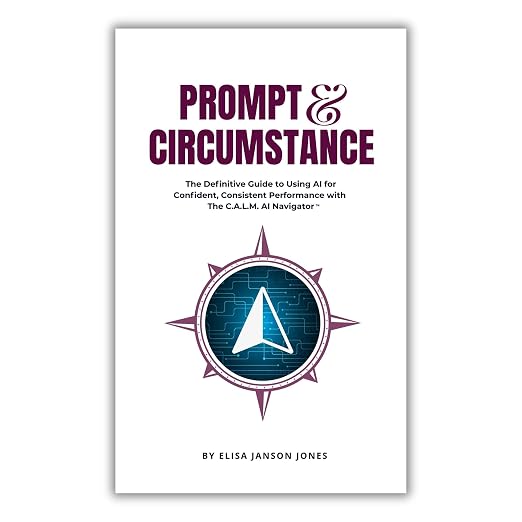
The book behind the training
Prompt & Circumstance
The Definitive Guide to Using AI for Confident, Consistent Performance with The C.A.L.M. AI Navigator™
Read it before you book, or hand it to your team afterward — every attendee in the four-session intensive gets a print copy included.
Before you book
Questions people ask first
Who is this training actually for?
Teams and organizations whose work depends on thinking, writing, analyzing, planning, or teaching — which is most of them. Associations, nonprofits, school and district teams, professional services firms, and small-to-mid-size businesses are the most common. No technical background required.
It works best when the group shares some kind of common work. Mixed-skill rooms are fine and normal; mixed-purpose rooms need a quick conversation first.
Our team's AI skills are all over the map. Will that be a problem?
No — it's the normal starting condition. The framework is the equalizer: beginners get a way in that doesn't depend on knowing tool trivia, and the people already using AI daily finally get a method for why some of their attempts work and others don't. Skeptics tend to do well here, because nothing is being oversold to them.
Do we need specific AI tools or paid subscriptions?
The framework is tool-agnostic and works with whatever you already have. Attendees get more out of the hands-on formats if they can access an assistant during the session, so we confirm on the intake call which tools your organization permits and design the practice around those. Subscriptions aren't included in the training price.
How customized is "customized"?
Every engagement starts with an intake conversation about your work, your constraints, and what a win looks like. Examples, practice scenarios, and prompts are built from your real tasks — not a generic deck with your logo dropped on slide one.
Online or in person?
Most sessions are delivered live online, which is also where the hands-on practice works best — everyone is at their own keyboard. In-person delivery is available; the session fee stays the same and travel is billed separately (see the fine print below).
Can we record it?
Recording rights aren't included by default, but internal-use recording can be arranged in writing before the session. Redistribution, resale, and use as standing onboarding content are handled as a separate license — ask on the call.
How far in advance do we need to book?
Three to six weeks is comfortable and leaves room for intake and customization. Tighter turnarounds are sometimes possible depending on the calendar — ask.
What happens after the training ends?
Your team keeps the framework, the reference materials, and the prompts they built. Because the method doesn't depend on any one tool or model version, it holds up as the tools change. Ongoing advisory and organization-wide adoption work is available through Sovereign+ if you want support past the training itself.
Can you do this as a conference session or keynote?
Yes — the one-hour overview is built for exactly that, and it's the format most conferences book. Keynotes, clinics, and multi-session tracks are quoted separately depending on the slot, the audience, and whether you need a recorded version for on-demand attendees.
We're a nonprofit or association with a tight budget.
A large share of this work is with mission-driven organizations, and Elisa has run them herself. Bring your real constraints to the call and she'll tell you honestly what's possible at your number.
One conversation, no pitch deck
Tell me what your team is stuck on. I'll tell you which session fixes it.
Bring your outcome, your timeline, and your budget. You'll leave the call knowing exactly which format to book — or that you don't need one yet.