

You have expertise.
AI should make it faster, not harder.
I'm Dr. Elisa Janson Jones — author of Prompt & Circumstance and creator of the C.A.L.M. AI Navigator™. I help solopreneurs and organizations use AI to think better, move faster, and get measurable results — without becoming engineers.

Insight-Led.
Action-Focused.
Future-Ready.
You don’t need to be wildly techy to thrive in an AI-powered world. You just need the right navigation system and the right set of skills.
Let’s build yours together.








































AI challenges are relatable.
I get it. That's why I designed the system to help you get results.
At some point, you've probably had this experience:
You open ChatGPT, type something in, get a response that's… fine. Not wrong. Not especially helpful either.
You tweak it. Try again. Maybe it improves. Maybe it doesn't.
And eventually you think, "Alright, I'll just do this myself."
So the tool that was supposed to save you time quietly becomes something you only use when you're already stuck.
The rollout is technically complete.
Everyone has access. There may even have been a training or two.
After that, things get… interpretive.
A few people take off with it. Most people don't quite know where it fits. And no one is entirely sure what "good use" is supposed to look like.
Meanwhile, leadership is asking reasonable questions about impact, and the answers are either vague or optimistic.

The part where this starts to hold up under real work
The pattern is predictable.
Someone tries AI, gets a few interesting results, and then… it never quite becomes part of how they actually work.
This is the structure I use to prevent that.
Same framework, whether you're working solo or trying to get an entire team to move in the same direction. The details change. The logic doesn't.
Clarity
Before anything else, we get specific.
Not "how could we use AI?" More like: what, exactly, should this be doing for us right now?
This usually means getting very clear on the output you need before you open the chat window. Not mid-prompt. Not after three retries. Up front.
This is the slower, more important work—understanding where AI actually supports your highest priorities, within real constraints, and in a way that can scale beyond a few enthusiastic early adopters.
Alignment
Once you know what's possible, the question becomes whether it's useful.
Choosing the right tool for the task sounds obvious. In practice, it's where most of the friction shows up. The goal is fewer tools, used more deliberately.
Tools are the last step, not the first. Alignment means designing a path where the technology supports the strategy—not the other way around.
Leverage
This is where things either compound—or quietly reset every day.
You stop starting from scratch. You build prompts, workflows, and systems that produce consistent results without requiring you to rethink everything every time.
This is less about tools and more about behavior. Leverage shows up as adoption—when people actually use what's been introduced, in a way that sticks.
Manifest
At some point, this has to show up in the real world.
Better outputs. Faster turnaround. More space to focus on the work that actually moves things forward—and, ideally, revenue that reflects that shift.
This is where structure matters: ethics, privacy, compliance, and repeatability. Not as constraints, but as the reason the whole thing holds together long-term.
Most people spend their time experimenting.
This is what it looks like to move past that.

How people usually start—and where it tends to go
Most people don't begin with a full-scale transformation.
They start with something small, see what happens, and then decide whether it's worth going further.
That's reflected here.
Prompt & Circumstance
Start here if you want to understand how this works before committing to anything larger.
Short, practical, and designed to change how you think about using AI—not just what to type into it.
Structured, time-bound
Focused on a specific outcome.
Less "learn everything," more "fix this part of your workflow so it stops taking longer than it should."
The Intuitive AI Collective
Ongoing access to the framework, prompt library, and a group of people who are actually using this in their work—not just reading about it.
One-on-one work
For when you don't want to keep piecing it together.
Focused work to design how this fits your business, your workflow, and your goals.
For leadership teams
A working session where we step back, look at what's already in place, and clarify where AI should—and should not—be playing a role.
For teams and events
Workshops are hands-on and practical. Keynotes shift how people think about adoption before they're asked to change behavior.
Tailored to your context, not pulled from a generic deck.
AI Transformation
We define priorities, map use cases, design workflows, and build something your team can actually use—not just understand.
Continued support
For organizations that don't want this to stall after the initial push.
So the strategy holds up as tools evolve, teams shift, and new use cases emerge.

I help people use AI to accelerate thinking, not replace it.
I'm Dr. Elisa Janson Jones — strategist, educator, and builder.
I help people figure out how AI actually fits into their work—whether that's a one-person business or a team trying to get everyone moving in the same direction.
My background spans education, corporate learning, and nonprofit leadership, which mostly means I've spent a long time watching what happens when new tools show up without a clear plan for using them.
Now I focus on making sure that doesn't happen.
That looks like turning strategy into something usable—systems, training, and workflows that hold up outside of a demo and actually show up in the work.

Make Monday your favorite day of the week.
Practical AI for solopreneurs. Every Monday at 10 AM Mountain.
- AI updates that you can actually use
- Prompts to try
- One small win for the week
- A C.A.L.M. AI tip
Drop your email below.
No spam. Just the kind of AI clarity most people won't find on their own.
Free. Unsubscribe whenever. Your email stays private.
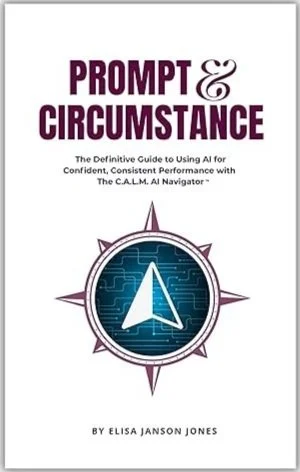
Prompt & Circumstance.
The book that teaches you how to think with AI — not just how to prompt it. Written for the solopreneur who doesn't want to become an engineer but does want to get more done before lunch.
- Clear frameworks for thinking with AI, not at it
- Prompt patterns you can steal on day one
- Real examples from real businesses — not SaaS demos